
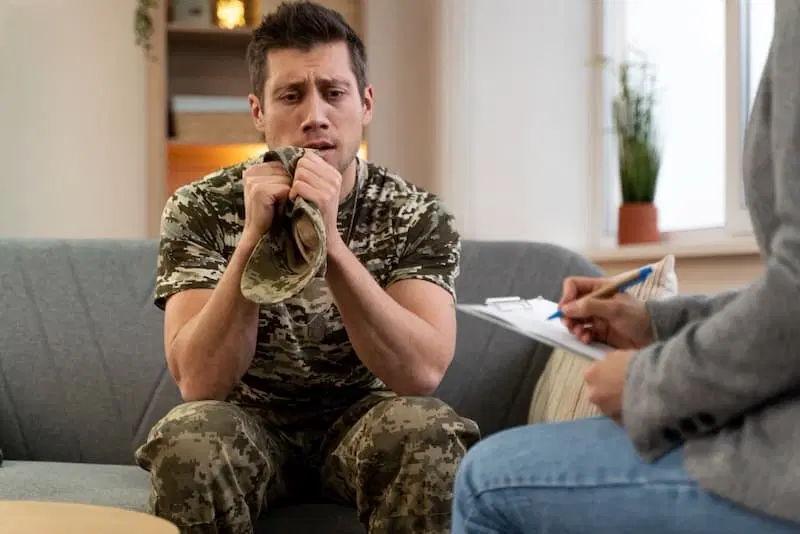
Most of us sensed that nothing would ever be the same after September 11, 2001. This was especially true for military members and their families.
The 9/11 terrorist attack would kick off the Global War on Terror, which would pull 1.9 to 3 million U.S. service members1 into operations in Iraq and Afghanistan. More than half of these service members would deploy more than once.
These soldiers would join millions of living veterans from former conflicts, including the Bosnia and Herzegovina intervention, Granada, U.S. invasion of Panama, the Vietnam War, etc.
If you’re one of the millions of veterans in the U.S., you may put on a tough face from day to day, but chances are, you bear mental health wounds that few people see. War has a way of leaving more than just physical scars.
Mental Effects of Combat Trauma
Post-combat mental health conditions commonly include:
Post-traumatic Stress Disorder (PTSD)
PTSD is defined as a psychiatric disorder affecting people who have experienced or seen a traumatic event (or series of events) that is emotionally or physically harmful or life-threatening.
Symptoms may include:
- Flashbacks
- Recurring memories or dreams
- Avoidance (of places or objects that remind you of the traumatic experience)
- Being constantly on-guard
- Being easily startled
- Angry outbursts
- Risky, reckless behavior
- Blaming self or others
- Loss of interest in things you used to like doing
- Feelings of shame
Depression
Symptoms may include:
- Feeling empty
- Feeling hopeless
- Feeling worthless
- Anger or irritability
- Feeling guilty or ashamed
- Loss of interest in hobbies or previously enjoyable activities
- Low energy
- Trouble concentrating
- Trouble sleeping or staying awake
- Weight loss or gain
- Thoughts of death or suicide
Other Effects
Elevated Suicide Rates
A recent report2 from the VA showed that veteran suicides outpaced the non-veteran adult suicide rate by more than 57%. It was also the second leading cause of death among veterans younger than age 45.
Substance Use Disorders (SUDs)
Veterans with mental illness frequently turn to substance abuse to dull their emotional pain. Among Afghanistan and Iraq veterans, 63%3of those diagnosed with SUDs also met the criteria for post-traumatic stress disorder (PTSD).
Relationship Difficulties
Deployments can take a heavy toll on relationships. A lot can happen during the span of a deployment that can change you, your loved ones, and the ways you interact.
Bridging those gaps can be hard. And if you are bringing mental health problems home from the combat zone, this could put even more strain on a relationship. A Rand4 study showed that accumulated months of deployment significantly heightened risks for divorce among military members.
You’re Not Alone
If you suffer from combat-related mental health disorders, you should understand that you are not alone. Research shows a high incidence of mental health disorders among veterans. For example, 14% to 16%5 of U.S. service members who were deployed to Iraq and Afghanistan have suffered from PTSD or depression.
So why does military service, particularly combat-related service, induce mental health problems? Here are some key factors:
- Seeing others harmed. Whether fellow soldiers or the enemy, witnessing injuries or killing can kick off PTSD, depression, and other mental disorders.
- Fear of harm to self. A constant fear of imminent danger can also trigger these disorders.
- Having to harm others. As one soldier put it, “I held two seemingly contradictory beliefs: Killing is always wrong, but in war, it is necessary. How could something be both immoral and necessary?” Even when you harm others out of defense, it can be tremendously morally disorienting and lead to mental health issues.
- Lack of a clearly defined objective. Good vs. evil can be easier on the psyche than more murky wars with unclear goals, unclear enemies, and divided support on the homefront.
- Lack of sleep. A state of hypervigilance, limited or irregular sleep opportunities, and uncomfortable sleeping conditions are all part of deployment. Sleep deficiency can trigger mental health problems or worsen existing ones.
- Lack of a support network. Deployments pull you away from your usual support circle. They can also put stress on typically supportive relationships. For example, you may feel distant from a spouse due to divergent activities and less frequent communication. Resentment can also build up between the soldier and the spouse at home who is bearing the burdens of the homefront.
- Repeated tours of duty. Any deployment can be hard on someone, exposing them to more danger, injury, and violence, upending their sleep schedule, and derailing their usual support network. Because the Global War on Terror played out over such a long period, it was common for troops to be deployed over and over again, increasing risks for mental health disorders.
- Traumatic brain injury. Studies6 show that anywhere between 10 and 20% of deployed service members have sustained concussions (a form of traumatic brain injury). Many of these are due to blast-related injuries incurred in Iraq and Afghanistan. Even before deployments, soldiers are at a higher risk for concussions due to military training, including hand-to-hand combat training and heavy weapon and munitions training. Concussions, and especially repeated concussions, have been associated with depression, anxiety, PTSD, and personality changes.
- Reintegration stress. While being apart from loved ones can be difficult, so can returning home to them. When families are forced to cope without a military member, it can be hard to make space for them when they return. The veteran may feel like they have been through something that no one understands and have trouble functioning as a civilian when they are so heavily marked by their military experiences.
- Physical injuries. War wounds can cause feelings of loss. Veterans often grieve the physical specimens they once were and the activities that they could once perform. They may experience feelings of inferiority and uselessness when they can’t contribute like they did before. Their injuries may steal their autonomy and leave them feeling like a burden to others.
Pre-combat Trauma
Although this article is about combat-related mental illness, it’s worth noting that just being a military member can lead to higher mental illness rates. This can be due to the ever-present challenges of achieving certain ranks and promotions, top-down leadership that can shut down opportunities to negotiate a better work environment, frequent moves and deployments, and sexual assault. (One study7 showed that 32% of female veterans and nearly 5% of male veterans screened positive for military sexual trauma.)
If you have experienced any of these stresses before going into combat, you could be layering new trauma on top of old trauma and heightening your risks for mental health challenges.
How Do I Qualify for Financial Help?
Knee arthritis: 38 CFR
- Diagnostic Code: 5003, 5010
- Typical Rating Range: 10% to 60% (with 100% ratings possible for severe cases with significantly impaired functionality
- Factors Considered: Degree of pain; limitation of motion, extension, and flexion; joint instability
Financial help in the form of VA disability payments is available for qualifying vets with service-related mental health disorders. To file for a VA disability rating for PTSD, start by getting a mental health diagnosis. You may seek this diagnosis from a private doctor or a VA health provider. This should include documentation of the severity of your symptoms.
PTSD is rated at 0%, 10%, 30%, 50%, 70%, and 100% based on the severity of your symptoms (in terms of frequency, severity, and duration) and how your symptoms impact your social and occupational function. The diagnosis code is 9411.
Once you have a diagnosis, you will need “medical nexus” documentation from a doctor. This is documentation linking your mental health disorder to your military service or to another service-connected disability. (An example of the latter would be that your chronic pain from your combat injuries is causing you to become depressed.)
Your doctor may write a nexus letter with wording such as, “It is at least as likely as not that [patient’s] mental health condition is connected to their military service.”
You can also write a personal statement and/or collect buddy letters, which are written by friends, relatives, co-workers, etc., who can document evidence of your mental health condition. For example, a spouse might write a letter describing how you have become increasingly agitated and angry since returning from combat. Another example of a buddy letter would be a friend documenting how certain noises and locations trigger violent behaviors in a way that they never did before your combat experience.
Remember that to file a successful PTSD VA claim, you will need to connect your PTSD to a “stressor.” A stressor is a traumatic event through which you were personally or indirectly exposed to actual or threatened death, serious injury, or sexual violence. (Note that certain combat medals and citations can serve in place of a stressor event.)
Remember that some mental health conditions may not manifest until months or even years after you have returned from combat. Or, they may manifest mildly after you return but get worse with time. If you were given a VA rating for your depression, anxiety, PTSD, etc., but believe it is too low, you may be eligible for up to 100 percent VA disability benefits.
What Other Resources Are Available?
In addition to VA disability compensation for combat-related mental health conditions, the VA provides many mental health resources.
These include:
National Call Center for Homeless Veterans, 1-877-424-3838, #1
This 24/7 resource is available to veterans who are homeless or at risk of becoming homeless. Callers will be assisted by trained VA counselors who can connect homeless vets (or their family members) with housing and health care/mental health care resources.
Veterans Crisis Line, 988, #1
Also available 24/7, this confidential hotline puts veterans and service members who are in crisis in touch with qualified, caring responders.
Real Warriors, 1-866-966-1020
Another 24/7 resource, this service is available through the Defense Centers of Excellence for Psychological Health and Traumatic Brain Injury. Representatives are trained to help connect those with TBIs, PTSD, and other psychological health issues with the best resources.
War Vet Call Center, 1-877-927-8387
If you need a listening ear to discuss your military experience or your transition from the military to civilian life, this center can put you in touch with veterans from several different eras.
Women Veterans Call Center, 1-855-VA-Women (1-855-829-6636)
This hotline is for women veterans and their families. Call representatives are qualified to understand and help with issues specific to women in the military.
1https://watson.brown.edu/costsofwar/costs/human/veterans
2https://www.mentalhealth.va.gov/docs/data-sheets/2022/2022-National-Veteran-Suicide-Prevention-Annual-Report-FINAL-508.pdf
3https://nida.nih.gov/publications/drugfacts/substance-use-military-life
4https://www.rand.org/news/press/2013/09/03.html
5https://pubmed.ncbi.nlm.nih.gov/34283458/#:~:text=PTSD%20features%20intrusive%20thoughts%2C%20flashbacks,as%20threatening%20as%20inciting%20trauma.
6https://www.army.mil/article/60542/deployed_docs_discuss_mental_health_brain_injury_treatment#:~:text=In%20fact%2C%20studies%20show%20anywhere,sustain%20a%20concussion%2C%20said%20Col.
7https://pubmed.ncbi.nlm.nih.gov/25373123/